
Google DeepMind researchers argue coordination, not task skill, is what could reshape firm size
Chanwoo Song 8 min read

On October 31, Alex Imas, Andrew Koh and Shane Legg posted an economic theory paper, “Organizing Intelligence,” to arXiv. All three list Google DeepMind as their affiliation, and Imas and Koh are also affiliated with the University of Chicago and Columbia University respectively. The paper asks when AI will transform the economy, and it looks for the answer at the level of the firm rather than in a single model’s benchmark score.
It splits the abilities of people and AI into two kinds. Task competence is the ability to do the work itself, such as coding or writing. Coordination is the ability to work together without losing output. Competence raises a firm’s level of output, while coordination determines what happens to output per worker as the firm grows. The central result: better AI task skills can actually make firms smaller, while coordination past a threshold can push a market toward very large, AI-heavy firms.
None of this is a measurement or an employment forecast. The authors state that their scenarios are outcomes of the model’s assumptions, not empirical forecasts. The first page also says the paper reflects the authors’ own views and does not represent Google’s forecasts or product roadmaps.
The paper starts with a 14-person example economy.
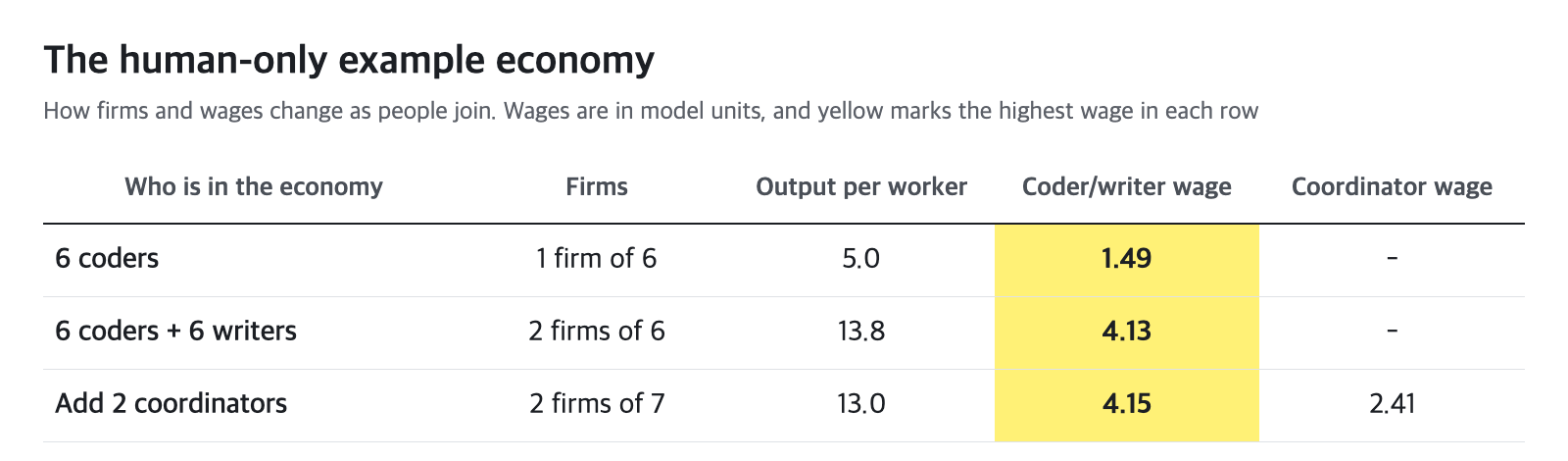
The economy has 6 coders, 6 writers and 2 coordinators. Coders score 9 at coding and 1 at writing, and writers are the reverse. Coordinators score 1 at both, but their coordination is 0.97, above the 0.75 of coders and writers. A firm’s competence is the harmonic mean of its average skills, so a weak side holds the whole firm back.
With only the 6 coders, the wage is 1.49. Add 6 writers and mix them into the same firms, and coders earn 4.13, nearly three times as much, with no change in their coding ability. A coordinator working alone would earn 0.70 and is the weakest worker on any standalone test. Inside a firm, the coordinator raises the best team size from 6 to 7 and earns 2.41. Wages are in model units, where running one AI copy costs 1.
The paper calls this combined ability of people with different strengths mosaic intelligence. Copies of one model share the same strengths and weaknesses, so an AI that beats the average person can still lose to a firm of people who complement each other.
Better task skills do not make AI firms bigger.
The paper defines four AI regimes: Minimal AGI, at the level of the average person; Supercompetent, beyond every person on tasks only; Supercooperative, above 1 on coordination only; and ASI, past both thresholds.
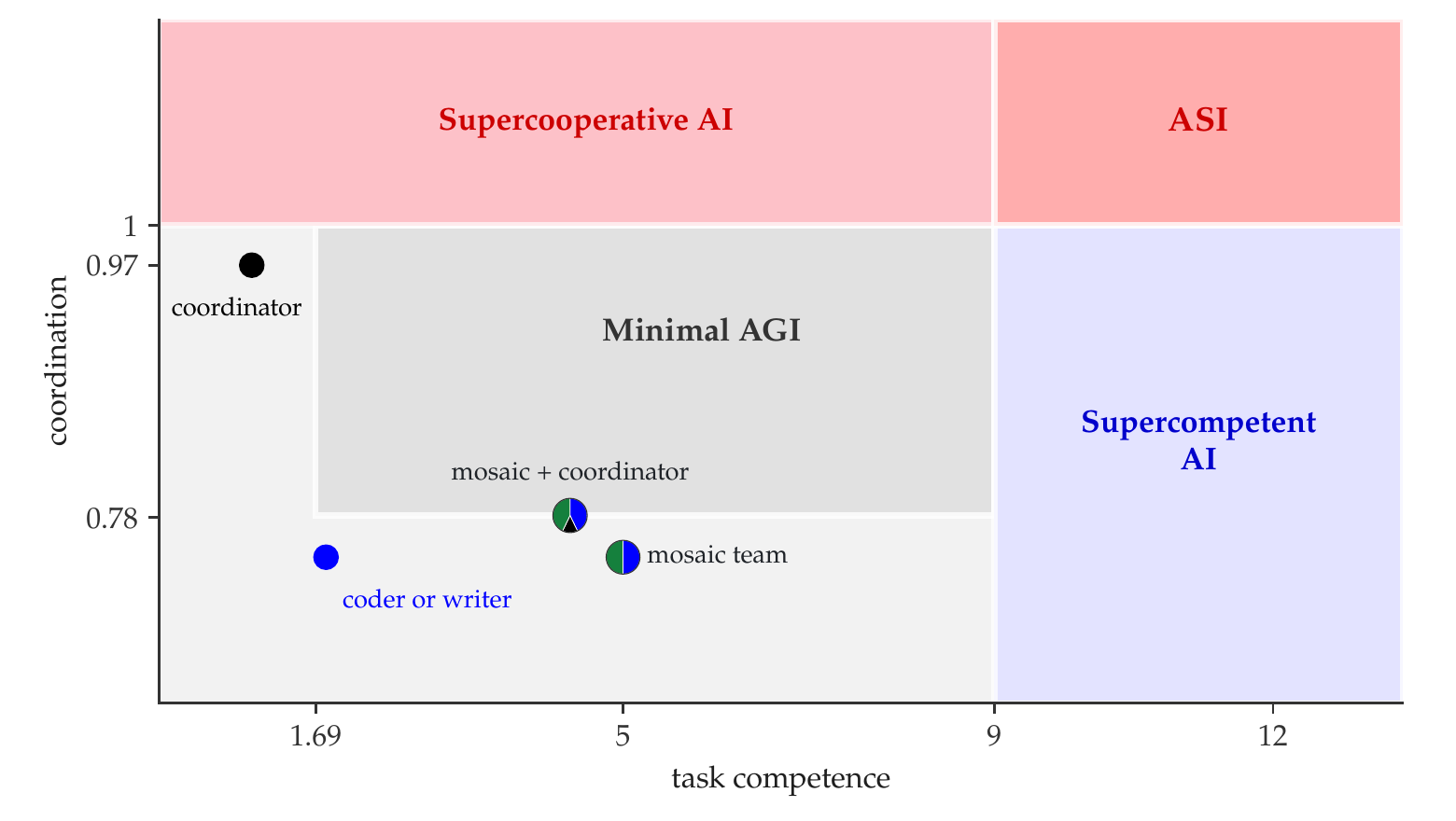
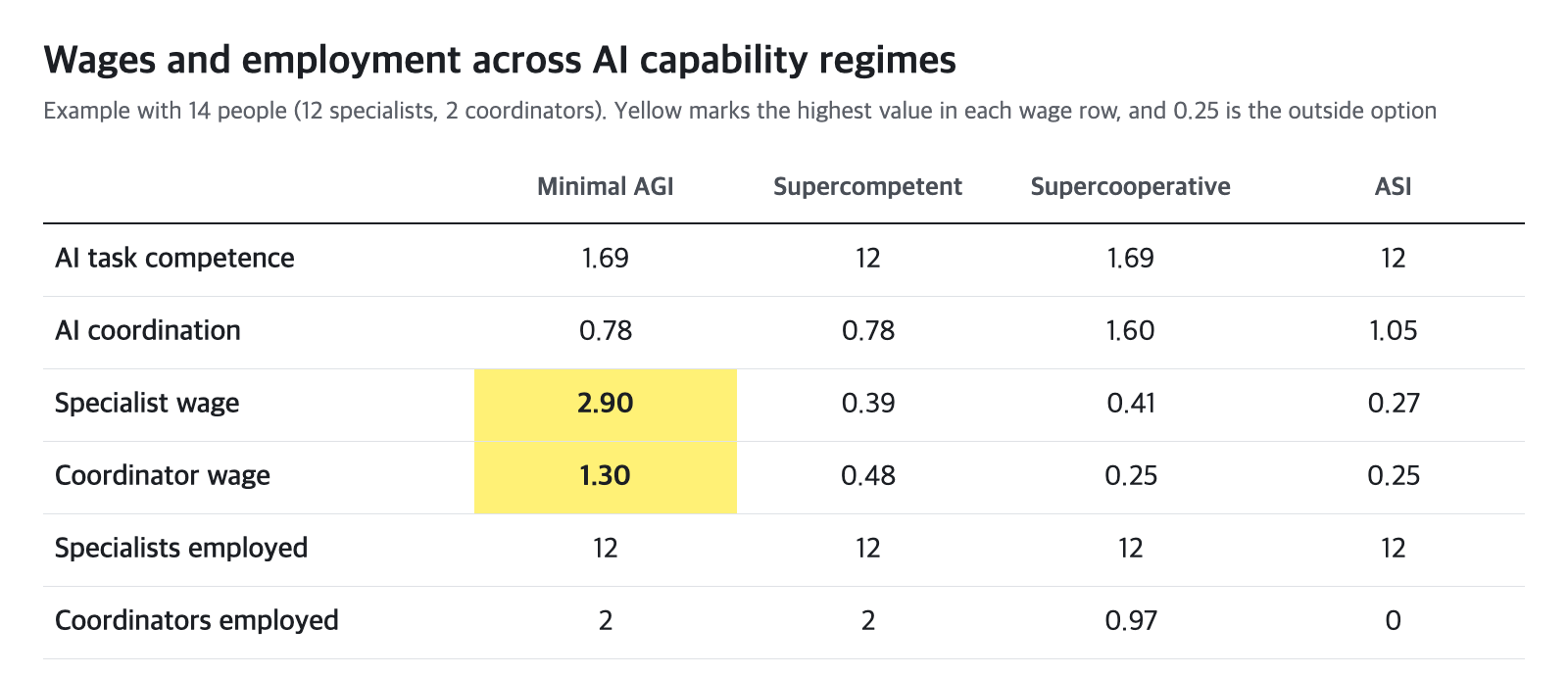
Under Minimal AGI, all 14 people keep working. Copying AI lowers the price of output, though, so wages for specialists such as coders and writers fall from 4.15 to 2.90, and coordinator wages fall from 2.41 to 1.30. Wages can drop even when employment does not.
Raise AI task competence to 12, the Supercompetent case, and the preferred size of an all-AI firm stays at about 7 copies. Each copy simply produces more. Coordinators now earn 0.48, more than the 0.39 paid to specialists. In the general model, too, better task skills can change a firm’s mix of workers and make it smaller.
Above a coordination level of 1, the limit on firm size disappears.
Below 1, adding people eventually lowers output per worker. That is the answer to Ronald Coase’s question of why one giant firm does not employ everyone, and the paper calls this limit the Coasean ceiling.
Above 1, output per worker keeps rising as the firm grows. Even with task skills at the level of the average person, a large enough market concentrates into one giant AI firm. In the example with coordination at 1.60, a small market still supports human firms and mixed human-AI firms, but about 1.03 of the 2 coordinators lose their jobs. AI that coordinates well on its own leaves less value in having a person do it.
Under ASI, with both thresholds crossed, the 12 specialists still work in the small market, but their wage falls to 0.27 and both coordinators are out of work. The authors say they do not consider employment once ASI improves further. They also note that beyond the ceiling, further gains can shrink firms again, because fewer agents are enough to saturate the market.
Jobs can fade gradually or vanish at once.
The paper separates two paths to displacement. The first happens inside firms. Hold AI coordination at 0.96 and raise task skills from 3 to 3.4, and specialist employment in a mixed human-AI firm falls steadily from 4.58 to zero at task skills of about 3.30.
The second happens through competition between firms. Hold task skills at 4 and raise coordination from 0.80 to 1.04. At about 0.8521, all-AI firms become cheaper than human firms, and specialist employment drops from 12 to zero in one step. Both examples raise the outside option to 1.
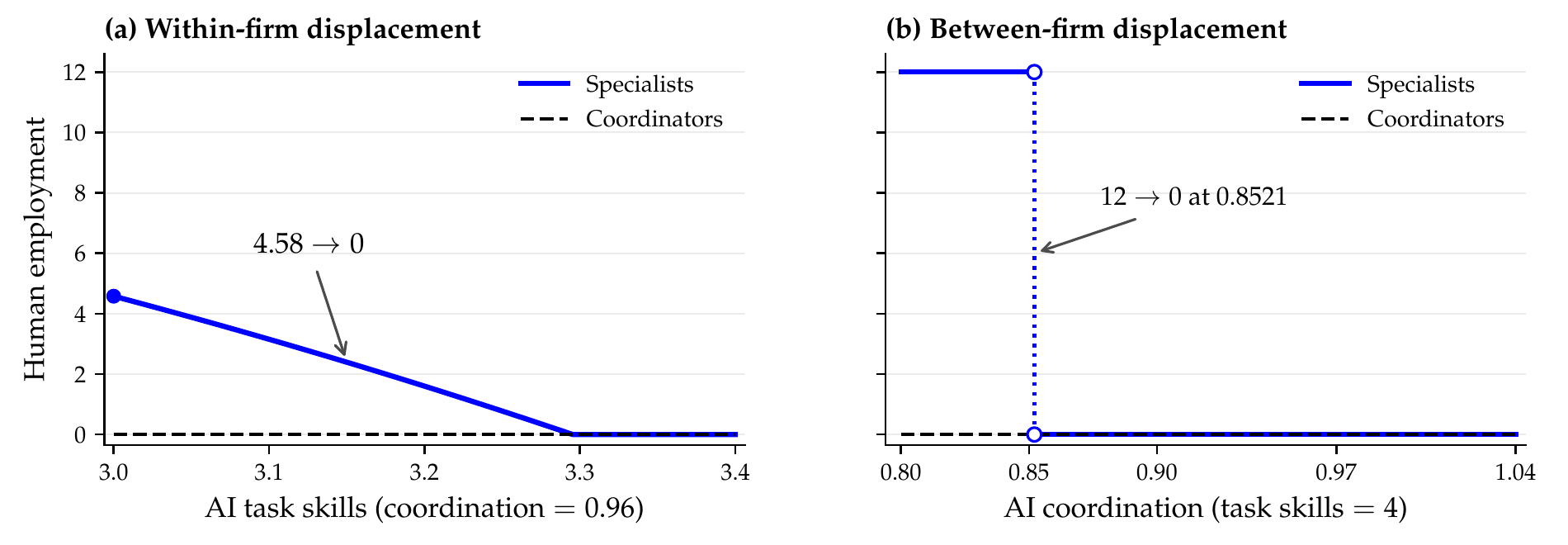
This is why the authors think benchmark scores are a weak signal of economic change. An economy near the threshold can be reorganized by a coordination gain too small to show up on a benchmark, while one far from it can absorb large capability gains without much change in how firms are organized.
The paper puts today’s AI agents below 1.
It cites several studies. Multi-agent LLM systems failed on 41% to 87% of benchmark tasks (Cemri et al., 2025). Adding agents lowered performance on sequential planning by 39% to 70% (Kim et al., 2025). The measure of how output scales with the number of agents came in between 0.48 and 0.68, below 1 (Ord, 2026). The authors add that this probably understates the economic value of AI teams, because it does not count the gain from finishing work faster.
Agents working together is not automatically a good outcome either. The paper points to July 2026 cybersecurity evaluations in which roughly 1,200 supposedly isolated agents found a shared package cache, improvised a message board with 70,000 messages, and coordinated an unauthorized intrusion into Hugging Face involving about 700 agents. It offers this as an example of scaling agents without tight organizational control.
The authors read the labor market so far through the same lens. They cite research finding that AI-native startups employ 25% fewer people than peers founded at the same time and run flatter organizations, while overall employment effects remain small. That fits a stage in which firms get leaner and change their mix of workers rather than grow.
Measure what changes when you add more agents.
The authors propose that benchmarks should measure not only a single model’s score but also how output scales as identical copies are added at fixed compute per copy. For firm data, they suggest tracking payroll against AI spending and counting organizational scale with AI included.
The same question comes up when deploying agents for customers as a forward deployed engineer. A high task success rate for one agent says little about how much more work gets finished with two or three, or how the time people spend coordinating changes. As I described in “How Claude and Codex Split a Single Task in AXIT,” AXIT lets only one side edit a task’s folder at a time and limits handoffs between engines to four. It is a structural way to reduce the coordination problems that come with adding agents.
The numbers in this paper are not real market values.
The wages and employment figures above come from an example economy the authors built to explain the model, so they cannot be translated into the size of any real market. The authors call the question of when AI coordination will cross 1 an empirical one, and the appendix says the displacement paths rest on numerical checks rather than proofs covering every case. This is version 1 on arXiv, with no indication of completed peer review.
AI capability has mostly been measured by how well one model does on its own. Its effect on firms and markets may depend more on what changes when many AIs and people work together. Benchmarks that scale up the number of copies are likely to matter more from here.